Differences in Tobacco Leaf Fermentation Across Regions — Cuba, Dominican Republic, Nicaragua, Honduras
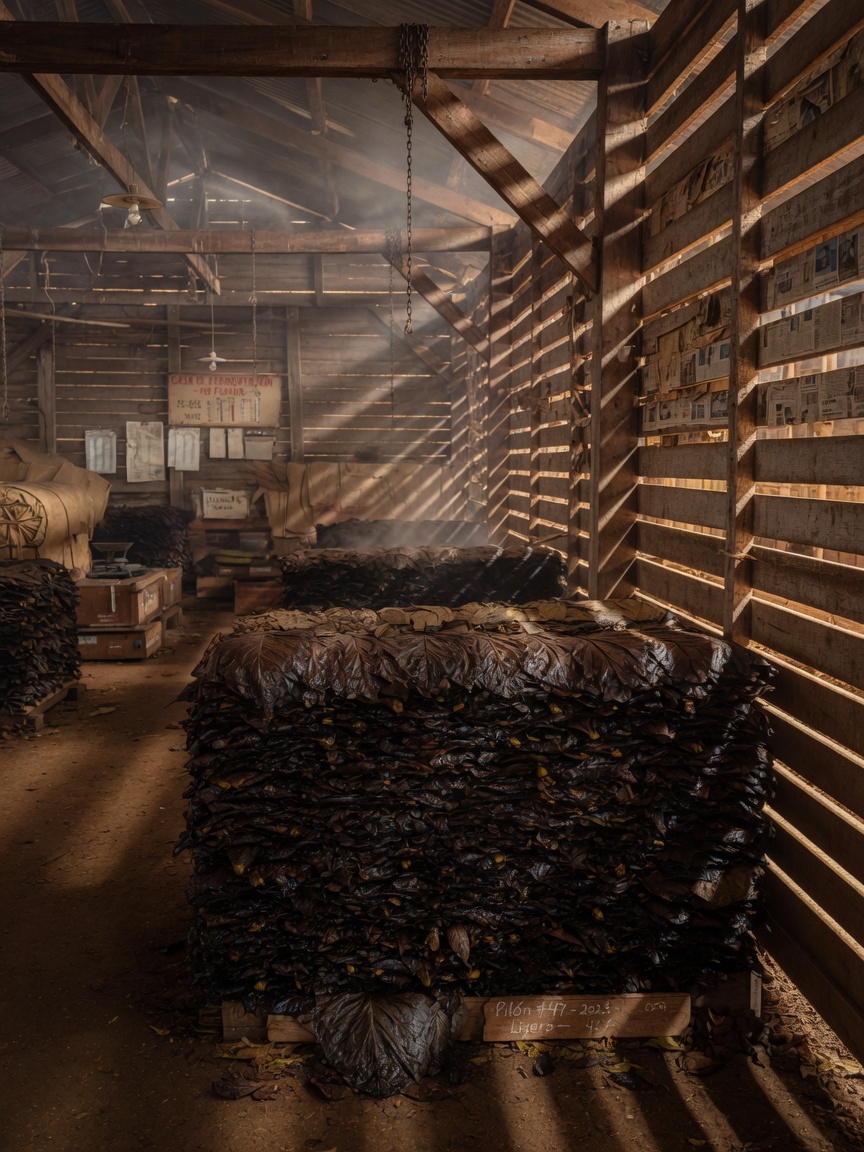
In March 2019, inside a curing-fermentation warehouse complex in Pinar del Río that is not open to the public, I inserted a thermometer into a genuine Cuban pilón for the first time. The pile stood about 1.3 meters high, with gavillas interlocked like bricks, and a PVC tube was plunged about 45 cm deep into the core. The needle settled steadily in the 34–35°C range — to a newcomer, this temperature felt "too mild," barely matching the textbook description of "fermentation steaming." The foreman gestured in Spanish: the rule here is slow, even, and better to dismantle than to burn. In November of the same year, in another fermentation room in Estelí, Nicaragua, I watched a ligero pile core climb to nearly 55–58°C before being broken down and turned, with ammonia so thick it stung the eyes. Both countries used the same term — "bulk fermentation" — but the leaves they produced flowed like two different rivers.
Later I visited several raw-material factories around Santiago in the Dominican Republic, as well as warehouses in the Danlí area of Honduras. The differences among the four countries' tobacco leaves certainly stem from soil, variety, altitude, and sunlight, but the real knife that rewrites "raw leaf" into "usable leaf" is fermentation: how high you pile, how moist, how hot you allow it to get, how many times you turn it, and at what point on the curve you stop. This article only addresses that knife's differences and how they translate into stylistic outcomes — not a four-country travel brochure, but a comparison of operational logic and flavor consequences.
I. Setting the Coordinate System: What Fermentation Changes
The typical path for cigar tobacco leaves is: harvest → curing → rehydration → bulk fermentation (one to several rounds) → sorting → bale aging → blending and rolling.
Fermentation is not a mystical ritual; it solves several very engineering-oriented problems:
- **Reduce green, harsh, and irritating nitrogenous compounds** (during which the ammonia smell typically rises and then recedes);
- **Drive the transformation of substrates** like sugars, proteins, and polyphenols, making room for subsequent Maillard-type reactions and aroma precursors;
- **Adjust the leaf's color, pliability, and burn usability**;
- **Make batches repeatable** — at least predictable within the same region and warehouse tradition.
- Fixed pile dimensions and weight ranges;
- Temperature and humidity records;
- More refined grading, with *wrapper / binder / filler* fermented separately;
- Post-fermentation aging time written into procurement contracts.
- **Willingness to use a higher pile temperature window** (still below the leaf-burning red line);
- ***Ligero* processed in its own extended cycle**;
- **More decisive turning** — better to tear down twice than risk center charring or edge mold.
- Don't pile too high blindly, to facilitate heat dissipation;
- Turn more frequently than any "theoretical calendar plan," **based on temperature and smell**;
- Target: medium-high intensity, clear earthy and woody notes, spicy without being scorched.
- **First-round *pilón***: core typically monitored around **35°C (95°F)** up/down, dismantled and restacked, cycle about several weeks.
- **Second-round *burro***: pile height about **1.2–1.8 m**; temperature control commonly discussed upper edge around **42–60°C**, **>60°C highly dangerous**.
- **Position differences**: *ligero* can take several weeks or more longer than *volado*.
- **Common failure mode**: uneven rehydration > the real source of most "mysterious off-flavors"; I have seen cases in all four countries where **the same blend, stacked just 12 hours after misting without proper equilibration**, resulted in entire edges being scrapped.
- **Cuba**: Long, but **long in the sense of low temperature**, serving recognizability.
- **Dominican Republic**: Long enough then stop, serving **smoothness and stability**.
- **Nicaragua**: Not long enough equals unfinished; but too long and too hot equals self-destruction.
- **Honduras**: Whether long or short depends on **the season's heating rate and mold pressure** — the calendar is secondary, pile condition takes priority.
- **The primary driver of fermentation differences among the four countries is the leaf's own chemical "hardness" and the warehouse climate, not myths about national character.** Bold leaves demand high temperature and long cycles; delicate leaves demand slow nurturing; hot warehouses demand frequent turns; wet seasons demand water control.
- **Tradition is not a romance; it is a set of risk controls developed through repeated trial and error in each locale.** Cuba's conservatism, Nicaragua's decisiveness, the Dominican Republic's process-orientation, Honduras's climate-sensitivity — all are rational choices.
- **Fermentation's contribution to stylistic outcomes is often underestimated.** The same "pepper" — under-fermented pepper carries green harshness, while properly fermented pepper sits over cocoa and sweetness. The same "creaminess" — clean Dominican fermentation yields nutty creaminess, while a musty fermentation yields wet cardboard.
- **There is no "unified optimal parameter set for all four countries."** Copying temperature targets without copying leaf type, moisture content, and pile scale will almost certainly fail.
- **Cuba: Slow nurture to preserve profile**
- **Dominican Republic: Refine for cleanliness**
- **Nicaragua: Forceful compression for complexity**
- **Honduras: Balanced transformation under heat**
In publicly available process descriptions, a common rhythm goes roughly like this: leaves are bundled into gavillas and first placed into a shorter pilón; when the core temperature rises to around 35°C (about 95°F), the pile is dismantled, leaves shaken loose, heat dissipated, and then restacked. The first phase can last on the order of about 30 days. After sorting and destemming, the leaves move to a taller burro (about 1.2–1.8 m), where the second phase lasts about 60 days, with pile temperature typically controlled within roughly 42–60°C (about 108–140°F). Going much above 60°C risks "burning the leaf and collapsing the aroma." Ligero (thick upper leaves) ferments longer, seco and volado shorter. Some brands add an even cooler third round (e.g., the historically mentioned Cohiba barrel-style slow fermentation), which is essentially about filing off remaining rough edges rather than creating a whole new terrain.
The numbers themselves are not sacred. The differences across the four countries lie in the climate, the inherent "firepower" of the leaf, and warehouse traditions — these determine how steep and how long each country dares to draw their curves.
II. Cuba: Slow Fermentation, More "Nurturing" Than "Attacking"
1. On-site Observations and Tradition
The hallmark of Cuban fermentation is not advanced equipment but discipline and conservatism. In Pinar del Río, especially the Vuelta Abajo region, warehouses turn piles frequently and limit each temperature rise cautiously. The first-round pilón is often more about "bringing the leaf to life and evenly distributing moisture and heat" than chasing rapid ammonia release. The second round likewise avoids "cooking" the leaf. During my 2019 visit, the core temperature hovered long-term in the 32–38°C range, with pile-turning triggered more by "feeling the texture + smelling the ammonia punch + checking the gauge" than by waiting for it to hit the upper limit.
Cuban tobacco leaves already carry a strong identity from the field: herbal, earthy, slightly mineral, capable of developing cocoa and leather later. The task of fermentation, in my view, is closer to:
**Suppressing rawness and ammonia bite just enough to make the leaf rollable and smokable, while doing as little as possible to "boil away" the delicate herbal, floral, and earthy notes.**
Hence the traditional approach leans toward multiple rounds, moderate-to-low temperatures, long durations, and small-step turns. The story of the third round/barrel-style slow fermentation is often repeated in Cuba's premium lines, and the logic holds: the first two rounds achieve "usability," the third continues to homogenize and round off under lower heat load. Does every Cuban cigar go through three rounds? Of course not. But "as slow as possible" is the cultural foundation of this production line.
2. Stylistic Outcomes
Common evaluations on the finished side: dense layers, clear earth and herbaceous notes, pepper optional but never relying on violent spice to carry the smoke. In a good vintage, people say "Old World elegance"; in a bad vintage, the same people complain "green, harsh, inconsistent quality" — the latter is often attributed to economic and raw material fluctuations, not entirely fermentation, but once fermentation goes wrong (uneven rehydration, delayed turns), Cuban leaf's "delicacy" first becomes "thin and sharp" rather than turning into Nicaragua's "thick and punchy."
3. My Judgment
Cuban fermentation philosophy is: better to extract a little less "power" and preserve a recognizable Cuban profile. Calling it "the most scientific fermentation" is romantic; calling it "the conservative strategy best suited to its own leaf structure" is more accurate. If you push Cuban leaf through the high-temperature, long-duration logic of Estelí ligero, you easily end up in an awkward middle ground that is "neither Cuban, nor as meaty as the New World."
III. Dominican Republic: Mild Leaf + Refined Fermentation, Aiming for "Smooth, Clean, Blendable"
1. Why It Appears "Not Aggressive"
The Dominican Republic has long been an important rolling and raw-material base for premium cigars globally. Leaves from the Santiago area, the Cibao Valley, and other growing regions are generally described as moderate to smooth: creamy, nutty, with light woodiness and sweetness, where spice and earth typically do not overwhelm balance. This does not mean fermentation is lazy — quite the opposite: mild raw materials are more sensitive to "dirt." A bit of mold edge, a touch of excessive anaerobiosis, a rehydration spot — these might be masked by pepper in a bold leaf, but in a Dominican blend they become "why is this cigar sour and dull."
I spent two mornings in February 2020 at the fermentation zone of a factory in Santiago. Their second-round burro pile temperature management leaned toward the middle range: mostly controlled around 40–50°C, with frequent turns, and workers specifically shook apart sticky leaves to prevent clumping at the edges. Ammonia was present, but not to the level of "opening the door chokes you" like an Estelí ligero room. The factory manager put it plainly: customers want repeatable mid-range flavor, not "a gamble on explosive aroma from every pile."
2. The Interweaving of Tradition and "Industrial Stability"
The Dominican Republic has both family-run small barns and scaled fermentation serving large export brands. The latter tends to emphasize:
This makes Dominican leaf extremely useful in global blends: as a filler skeleton or a smooth mid-range, it rarely causes problems; as an all-Dominican blend, it wins through cleanliness and creaminess rather than impact.
3. Stylistic Outcomes and Pitfalls
Done well: smooth, clean, natural sweetness, clean finish.
Done poorly (common): shortening the second round to chase yield, or excessive rehydration causing localized sourness and mustiness — smoking like "a damp cardboard box that hasn't aired out, with faint ammonia."
4. My Judgment
The core KPI of Dominican fermentation is not "making the leaf stronger" but "making the leaf cleaner, more stable, and more blendable." If you only love Nicaragua's pepper and cocoa heft, Dominican might taste "bland" — that's a difference in objective functions, not a matter of superiority.
IV. Nicaragua: Bold Leaves Must Be "Subdued" — Fermentation as Taming
1. The "Firepower" from Volcanic Soil
Volcanic soils in Estelí, Condega, Jalapa, and other areas typically produce thick leaves high in oils and intensity, with pepper—cocoa—leather—earth across the board. Ligero is especially demanding: high in protein and nitrogenous compounds, nearly unsmokable raw. An old industry saying rings particularly true here:
**Nicaraguan tobacco leaves often require longer, more thorough fermentation and aging to suppress aggression while retaining complexity.**
2. On-site: The High-Temperature Window Is Used More Fully
In June 2021, at a fermentation room in Estelí, a ligero core read close to 56°C before dismantling. The workers said their red line was around 58–60°C: dangerous above that, but if the pile just idles below 40°C, the "green and harsh" character won't come out, and subsequent aging can't fully salvage it. During turning, the ammonia was extremely strong; some workers wore half-face respirators. Leaf color shifted from greenish-brown to deeper, oilier brown. The total second-round cycle for ligero is commonly stretched to two months or more, and some batches receive a third round or extended bale aging.
The tradition here is not "Cuban-style slow nurturing of delicate aromas," but:
3. Stylistic Outcomes
Successful taming: thick, spicy, sweet-bitter coexistence, pepper and cocoa stand firm, long finish.
Failed taming: two extremes —
① Under-fermentation: ammonia, green, throat-irritating;
② Over-fermentation: hollow aroma, artificial sweetness, like "over-toasted wood chips," power remains but the soul is gone.
4. My Judgment
Nicaraguan fermentation philosophy is confrontation and transformation: the leaf is too strong, so the process must be aggressive enough, but not so aggressive as to kill the layers. It is not on the same track as Cuba. Copying "high-temperature long fermentation" onto Cuban delicate leaves would ruin their profile; grafting "Cuban moderate-low-temperature slow nurturing" onto Estelí ligero often leaves it not fully tamed.
V. Honduras: Compromise Under Hot Climate — "Earth—Spice—Wood" Balance
1. Growing Region
Honduras (especially Danlí and other growing areas) has long been caught between "Cuban traditional ideals" and "Nicaraguan power aesthetics." In terms of variety, it commonly grows Cuban-descended lines (such as Criollo and Corojo-related cultivation traditions), yet the climate tends to be hotter and drier, so the leaves can be intense, aromatic, spicy, and woody, but not necessarily replicating the same type of heft as Estelí.
2. Pragmatic Fermentation On-site
In April 2022, near Danlí, I observed a second-round pile for some mid-to-upper leaves. The outdoor temperature was already high, and the indoor pile core heated up faster than a comparably structured pile in the Dominican Republic. The foreman's strategy:
They don't romanticize a third round; they focus more on not letting the edges mold in hot season and not pushing the center past 60°C. At the humid-hot transition season, rehydration water must be strictly controlled — I once saw a batch where excessive evening misting combined with poor nighttime ventilation produced gray-green spots on pile corners, requiring full dismantling and inspection, with losses painful by the kilogram. The problem is not that "Honduras doesn't know how to ferment," but that the climate narrows the margin for error.
3. Stylistic Outcomes
Done well: medium-full to full, earthy, woody, light pepper, a touch of sweetness, more powerful than typical Dominican, yet often with a bit less "hammer blow" than top Estelí ligero blends.
Done poorly: uneven fermentation in the dry-hot season → outer dry, inner wet, or outer wet, inner scorched, with split smoking character; or overpursuing a "Nicaragua-like" profile with high-temperature forcing, losing one's own earthy-woody balance.
4. My Judgment
The optimal solution for Honduran fermentation is not to imitate any other country, but to achieve stable medium-high-intensity transformation in a hot warehouse environment. What it fears most is identity anxiety: one moment learning Cuba's slow approach, the next learning Nicaragua's aggressive style, with pile-temperature strategy swinging back and forth — then batches become inconsistent.
VI. Cross-Comparison: The Same Set of Actions, Four Countries Applying Different Force
| Dimension | Cuba | Dominican Republic | Nicaragua | Honduras |
|---|---|---|---|---|
| Leaf's "raw firepower" | Medium-high but fine profile | Medium to medium-soft | High to extremely high (*ligero*) | Medium-high |
| Pile temperature attitude | Conservative, avoids burning aroma | Mid-range stable | Willing to use high window to tame | Constrained by hot climate, frequent turns |
| Cycle tendency | Multiple rounds, can be very slow | Enough is stable, serves the blend | Long cycles, *ligero* especially long | Pragmatic medium-long |
| Main fermentation goal | Preserve Cuban profile + remove rawness | Clean, smooth, repeatable | Reduce harshness, retain complexity | Even, stable, earthy-woody-spicy balance |
| Turn trigger | Sensory + frequency, leans frequent | Process-driven + temperature/humidity logs | High temperature threshold triggers dismantling | Climate-driven, more sensitive |
| Typical risks | Too slow or raw material fluctuations revealing green harshness | Short cycles leading to musty sourness/blandness | Under: ammonia harsh, Over: hollow aroma | Humid edges mold, too-rapid heating in hot season |
| Style outcome keywords | Herbal, earthy, dense | Creamy, nutty, clean | Pepper, cocoa, heavy | Earthy, woody, spicy balance |
At the operational level, a few more checkable numbers (industry common ranges, not a single factory's standard):
VII. Traditional Practice vs "Stylistic Outcome": How I Connect Them
Many people ask: "Is longer fermentation always better?" The on-site answers from the four countries are:
So my clear view is:
If I am allowed only one sentence to label each country's fermentation — not comprehensive, but memorable:
VIII. Final Thoughts: How to Use These Differences
If you work in blending or procurement: when buying Nicaraguan ligero, ask about fermentation and aging months first, don't just look at the origin label; when buying Dominican filler, smell it first for cleanliness; when dealing with Cuba, first accept batch variation and slow logic; when looking at Honduras, first ask about seasonal warehouse humidity management, not listen to "we have Cuban seeds" stories.
If you work in tasting: when sampling at the same price point, you can prioritize attributing "ammonia, greenness, hollow, scorched" to whether fermentation and aging were fully executed, before talking about soil mythology. In 2023 I did a horizontal tasting at home of four countries' medium-format cigars: out of two labeled Nicaraguan, one had cocoa long finish under the pepper, the other was throat-irritating in the first half — same country label, fermentation completion a whole level apart. Region names are loud, but the temperature curve inside the pile does not lie for you.
The fermentation difference, at bottom, is that four countries are answering the same question: How do you turn a leaf from the field into something that can be lit with confidence and still be recognized? The answers differ, and that is why the cigars differ.